You Will Prevail.

I don’t know about y’all, but I have been having a rough time maintaining my motivation this semester. I’ve been feeling an increasing amount of stress, and it’s been harder to manage than it normally is.

I’m writing this blog post because I’m sure that I’m not the only one who feels like this sometimes.

I want you to know that you’re not alone in this.

It is OKAY to admit that you get overwhelmed sometimes.

It is OKAY to admit that you are exhausted sometimes.

It is OKAY to be unmotivated sometimes.

It is OKAY to want to give up sometimes.

We all go through times when we feel that we can’t handle any more stress or work put on us. There is nothing wrong with you.

When you go through these times, think about why you put yourself into the situation that you are in. For example, when Pharmacy School gets overwhelming, I try to remember the reasons that I’m here. My passion is helping people. I’ve been on this path since I was 12 years old. This is what I have always wanted. I LOVE my profession. Those are the reasons that I’m in this profession. That is why I’m in school. If I keep these motivations in the forefront of my mind, it’s easier to get back to work and focus on what I need to do.

What is it that gets you up in the morning? What is it that motivates you? Try to bring that to the forefront of your mind.

And when in doubt…

Breathe.

You’ve got this!

Stay Golden,

Emily
Preparing for Rotations

Hey guys! I’m writing today to list out how to best prepare to be on your A-Game when you start APPE rotations. Note: This is just what has helped me feel prepared as I go into rotations in May. Other things may work better for different people.

1. First things first, during the first 3 years of pharmacy school, study hard and study well. It is beneficial to work hard to get short-term memory into long-term memory so that you remember all the important stuff for all of the years ahead of you in your career. One of the ways that I do this is to make Quick Disease Fact Sheets after each disease state (or set of disease states) tackled in pharmacy school. I have discussed these before and the link to that blog post is here. You can also do the same thing with specific medications or classes of medications to make sure you remember the BIG, IMPORTANT points.

2. Second, it is important to continue studying, even when you begin rotations. What has been beneficial to me is to buy an RxPrep book (several years old) that was relatively cheap on Amazon. I am going through these topics nightly so that I’m well versed in what I need to know. We do not receive our RxPrep book for the current year until around September/October, so having the older model around before that comes will prove worthwhile.

3. Stay organized. It is very important to remain organized as APPEs are approaching. You should know which rotation is coming up when so you know where to focus your energy in the week or so leading up to that rotation. For example, if your first rotation is a cardiology rotation, it would be a good idea to brush up on the cardiology disease states before heading into that rotation.

4. Be prepared to be wrong or to not know an answer. It is important to be okay with not knowing everything. As pharmacy students, a lot of us are worried about being seen as ignorant. However, the preceptors on rotations understand that it is impossible for us to know everything about the world of pharmacy. A lot of that comes with being in the career field itself. A lot of the time, they aren’t testing our knowledge, but are testing our ability to admit when we don’t know something and our ability to look it up in a reputable source. This is not to say that they don’t expect us to know something… I mean, if they ask you what the brand/generic name or indication is of something… you NEED TO KNOW that.

5. And last but not least, the most important way to prepare for APPE rotations is to just trust yourself and breathe. It will all be okay. You’ve got this. WE’VE GOT THIS. I’m right there with you. If you ever need anything, feel free to reach out.

And as always…

Stay Golden,

Emily

Study Tips: Final Exams in Pharmacy School

In order to best study for final exams, I start studying ~3-4 days BEFORE I EVEN THINK THAT I NEED TO STUDY for an exam. It is critical to give yourself enough time. Here are some tips that I have to make that happen:

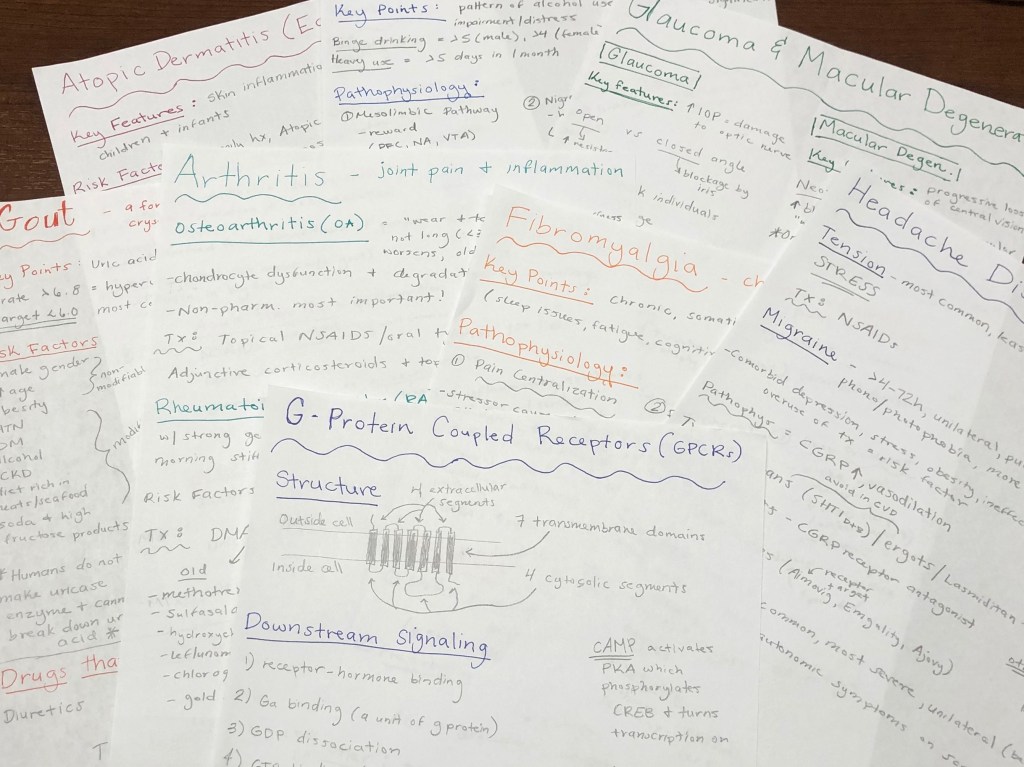
Make “Quick Disease Fact Sheets” or “Quick Medication Fact Sheets”

Example Quick Disease Fact Sheets That I’ve Created

I suggest for Disease States to focus on Key Features of the Disease, Pathophysiology, Risk Factors, Medication Management, and Non-Pharmacological Interventions. For Medications, I suggest focusing on Indication, Generic and Brand Names, Side Effects, and Therapeutic Class. It might be helpful to include pictures and charts.

Create a Rough Schedule for Studying

By this, I mean plan out which days leading up to exams that you are going to spend on each subject. For example: Monday: Pharmacotherapy 1, Tuesday: Research and Design, Wednesday: Integrated Pharmaceutical Sciences 1, etc.

Listen to Study Music

Here, I’ve attached a Study Music Playlist that I listen to on Spotify! It may be helpful to create your own.

Avoid Distractions

Put that phone down. Turn off that TV. Go somewhere quiet. Anything to help you avoid distractions.

Use a Timer!

There are lots of Study Timers online. I like the Pomodoro Method of Studying where you have 25 minutes of studying and then a 5 minute break. After an hour, you get a 15 minute break. Here is a useful online timer!

TAKE BREAKS

Going along with the last one, remember to take breaks! Your brain will stop absorbing information after about 20-25 minutes without a break because, as humans, we have a short attention span.

Avoid Cramming

This kinda goes without saying, but I feel like I still have to say it. Don’t wait until the last minute to study.

Make Quizlets or Practice Tests

This one has worked really well for me over the year. Being able to create my own questions with the material gets me thinking about it in different ways. I’ve even been able to anticipate almost the exact question that a professor is going to ask.

Focus on What You Don’t Remember!

If you spend most of your time going over the stuff that you got right on previous tests, you are going to neglect the stuff that you had a hard time with. The point of studying is to get a better grasp on the things that you don’t know or have a hard time remembering.

Get some SLEEP.

It is extremely important to sleep, especially during this time. It allows you to better retain information and leads to increased performance.

Good luck on your exams!!

Stay Golden,

Emily